What is Hermes Agent? A Beginner's Guide to the Self-Hosted AI
What is Hermes Agent? A beginner's guide to the open-source AI from Nous Research, how it differs from Claude and ChatGPT, and how it compares to OpenClaw.
If you've used Claude or ChatGPT, you've used an AI that pretty much forgets you every Monday morning. Hermes Agent doesn't work like that. It's an open-source AI agent that lives on your own server, remembers what you teach it across sessions, and writes its own skills as it goes. Built by Nous Research and released in Feb 2026, it has quickly become one of the most talked-about projects in agentic AI.
💡 In this article, we'll cover:
1. What Hermes Agent actually does
2. How Hermes differs from Claude and ChatGPT
3. Hermes Agent vs OpenClaw, the closest competitor
4. Who Hermes Agent is for
5. What's next for Hermes Agent?
For a quick definition: an AI agent is a program that uses a language model to actually do things, not just reply to you. It can run commands, browse the web, send messages, and chain tasks together with minimal hand-holding.
What makes Hermes stand out from other agents is simple: it gets better the longer you use it.
What Hermes Agent actually does
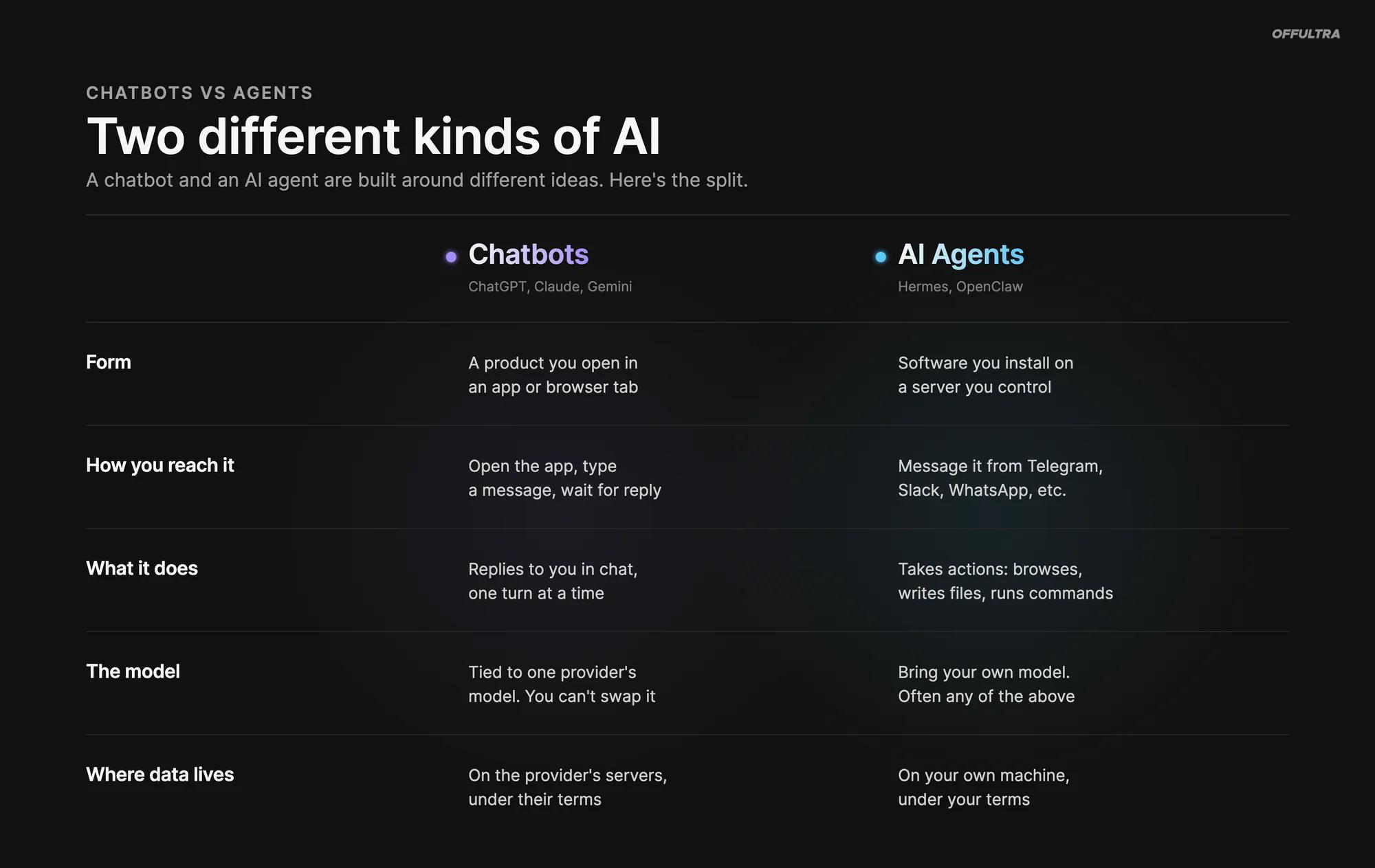
The simplest way to think about Hermes is as an always-on assistant you can reach from wherever you already chat. It plugs into Telegram, Discord, Slack, WhatsApp, Signal, and roughly two dozen other platforms through a single gateway. Send it a message, and it can do real work on the other end. Web searches, file operations, browser automation, terminal commands, scheduled tasks, and so on. There are over 40 built-in tools, plus extensions for anything not covered.
What sets it apart is the learning loop sitting underneath. Say you ask Hermes to pull the week's sales figures from a spreadsheet, format them into a summary, and post it to your team's Slack. The first time, it works out the steps as it goes. But it also saves what it learned as a skill, so the next Monday you can just say "do the weekly sales summary" and it knows exactly what you mean. Those skills are searchable, shareable, and refined automatically as the agent uses them. The memory system, built on full-text search with LLM-based summarisation, also lets it recall context from any past session without you re-explaining the project.
Hermes also runs on whatever model you point it at. OpenAI, Anthropic, Google, or local open-weight models on your own hardware. It's provider-agnostic, in their words, which means you're not locked into anyone's pricing or terms.
How Hermes differs from Claude and ChatGPT
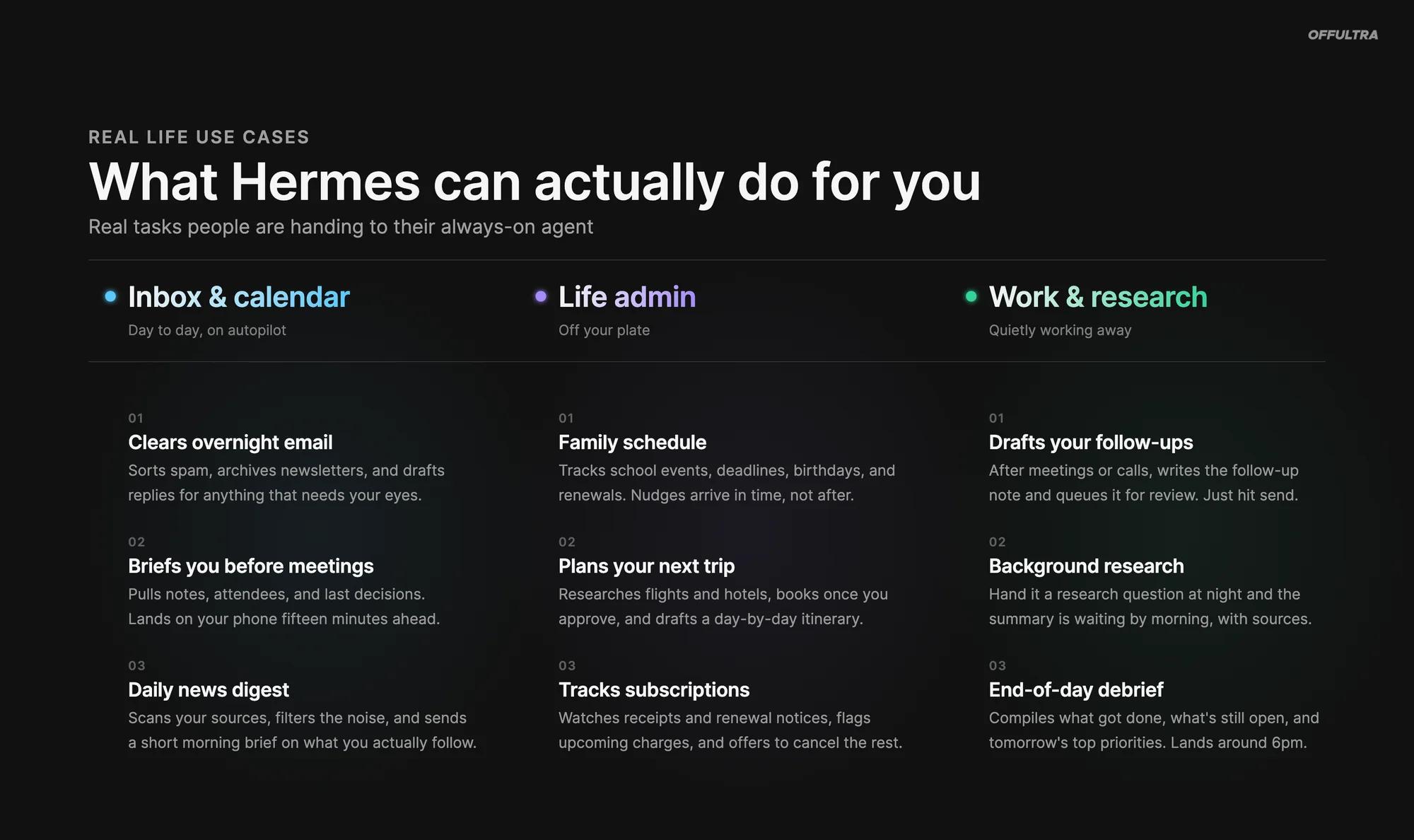
Claude and ChatGPT are products. You open an app or website, type a message, and get a reply. They have some memory features, but they're fundamentally session-bound. Close the tab and most of what you did is gone.
Hermes is infrastructure. You install it on a server. You give it a model API key (which might be Claude or ChatGPT under the bonnet, ironically). And it runs continuously, listening for messages, executing scheduled tasks, building up a long-term picture of how you work.
That distinction matters. Chatbots wait for you. Hermes can work while you sleep.
The other practical difference is where your data lives. Claude and ChatGPT both keep your conversations on their servers under their terms. Hermes stores everything locally on whatever machine you've set it up on. For people who care about privacy or want their data to actually belong to them, that's a meaningful split.
The rest of this post is for OFFULTRA subscribers.