Can AI Do Your Bookkeeping Yet?
Can AI do your bookkeeping? It can categorise, match and chase invoices, but benchmarks show it still slips on full month-end close. How to use it safely.
Bookkeeping is the job most small business owners would hand to AI first. It's repetitive and rule-based, and nobody started a business to categorise receipts.
So can AI do your bookkeeping now? Partly. It's good at the grunt work. It's still unreliable at the part that makes books trustworthy: getting every number right, every month, without drifting.
What AI bookkeeping can handle today
The big accounting platforms have built AI into the screens you already use. QuickBooks' Accounting Agent, launched for US customers in July 2025, "automates bookkeeping and transaction categorization, and assists in reconciliation", according to Intuit's announcement.
What it handles well:
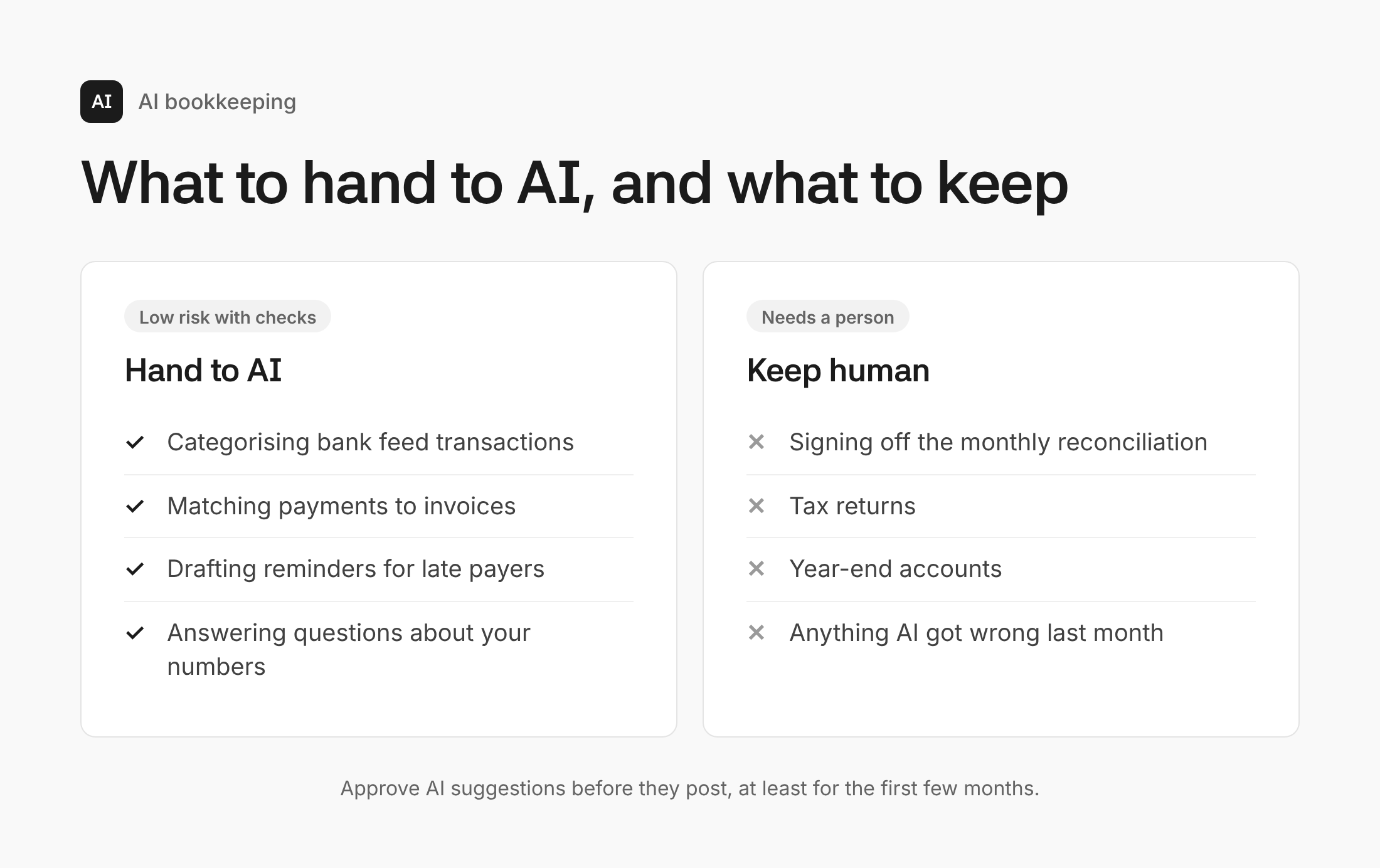
- Categorising transactions. Suggesting a category for each bank feed line and learning from your corrections.
- Matching payments. Pairing money in with the invoices it belongs to, and flagging what doesn't match.
- Chasing invoices. Drafting reminders and follow-ups for late payers.
- Answering questions about your numbers. Claude's connector directory lists both QuickBooks and Xero, so a general assistant can read your books and answer plain-English questions.
A question worth asking once your accounting software is connected:
Using my accounting data, list every customer with an invoice more than 30 days overdue, the amount owed, and how many times they've paid late this year.
Why AI can't run your books on its own
Two benchmarks this year tested leading AI models on real accounting work. AI Manual hasn't run its own ledger test, so this piece relies on theirs.
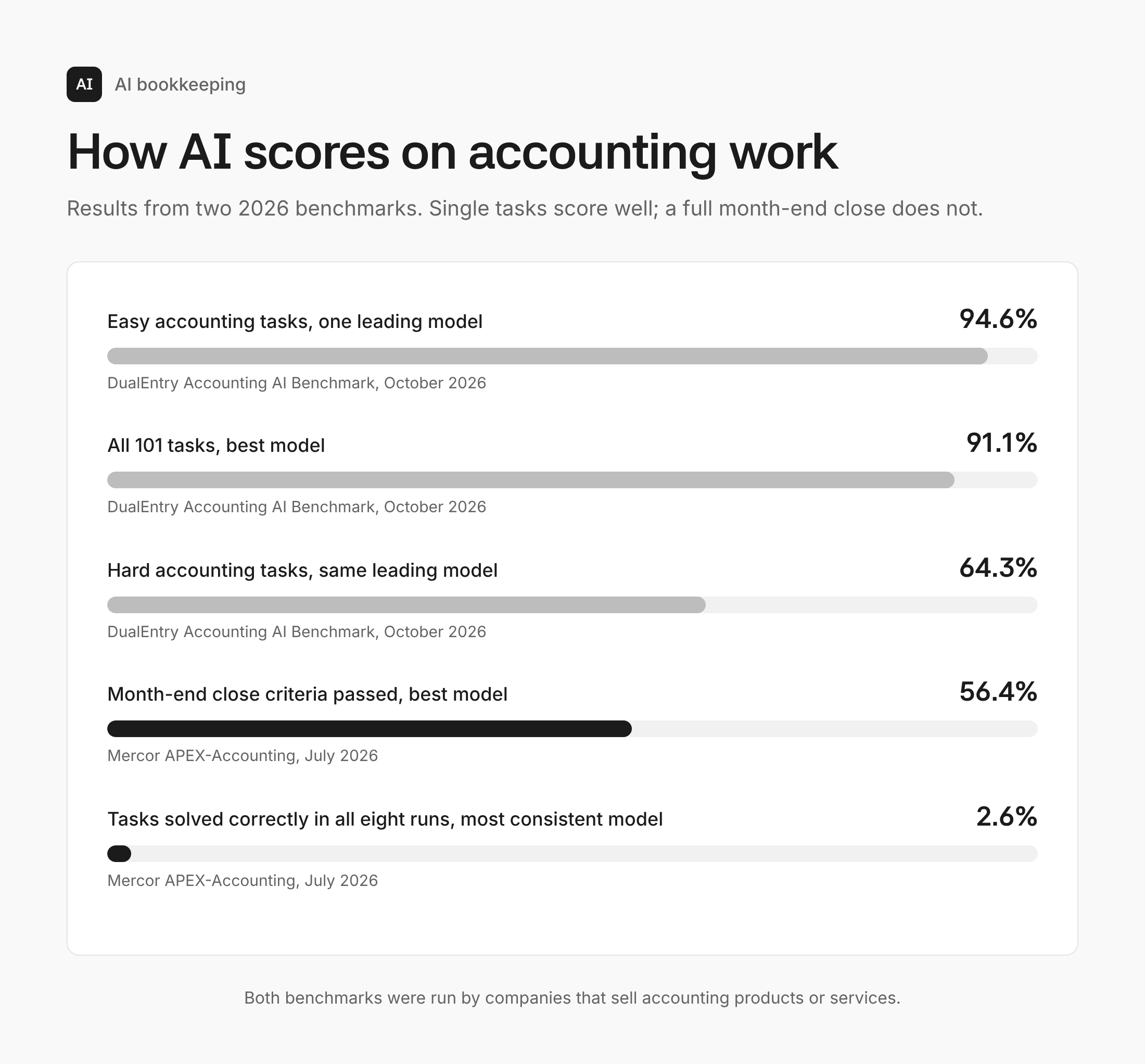
Mercor's APEX-Accounting (July 2026), built with Ramp, set 160 month-end close and bookkeeping tasks written by accountants. The best model passed 56.4% of the grading criteria, and "even the most consistent model solved just 2.6% of tasks correctly in all eight runs".
DualEntry's Accounting AI Benchmark (October 2026) looked kinder: the top model scored 91.1% across 101 tasks. But scores fell sharply on harder work, with one leading model dropping from 94.6% on easy tasks to 64.3% on hard ones.
Both are run by companies that sell accounting products or services, so treat the figures with some caution. Still, 91% sounds high until you remember books have to be right every time. One wrong entry in 10 is a mess your accountant bills you to unpick.
Where AI bookkeeping goes wrong
- Pasting bank statements into a chatbot. Turning a PDF statement into a spreadsheet is where general chatbots slip: dropped rows, swapped digits and missing minus signs, according to a roundup of accounting AI tests in Public Accountant.
- Errors that compound. In Penrose Labs' AccountingBench, reported in the same piece, AI balances were within 1% of human accountants' after the first month, then drifted more than 15% apart over the following months. That test dates from 2025 and newer models have shipped since, so the gap may have narrowed.
- Wrong, but confident. Mercor found roughly seven in 10 failures among the top models came from flawed reasoning, such as spotting a discrepancy early and then contradicting it later. Learning how to tell when an AI is guessing helps you catch these.
- Tax and year end. Mercor's benchmark left out tax, audit and multi-currency work entirely, and those are the areas where a mistake can mean a penalty.
The setup that works
- Keep AI inside your accounting software, where every suggestion sits next to the transaction it came from.
- Approve suggestions before they post, at least for the first few months, until you trust its patterns.
- Reconcile monthly, yourself or with a bookkeeper. If balances don't tie, stop and find out why before going further.
- Leave tax returns and year-end accounts to a qualified accountant.
Bookkeeping fits a wider pattern in what AI can and can't do for a small business: it handles first drafts well, but a person should sign off the result.
Get AI advice built around your business
AI Manual is building a service that learns how your business runs and shows you exactly where AI fits and where it doesn't, bookkeeping included. It isn't open yet. Contact us and you'll be among the first in.
Treat it like a junior bookkeeper
AI is useful for categorising, matching and chasing invoices, as long as someone checks its work every month. Responsibility for the accounts, and for any tax owed on them, stays with you and your accountant.