Can AI-Written Content Still Rank on Google?
Can AI-written content rank on Google? Yes, but new data shows human-led pages win the top spot. What Google's latest guidance says and how to publish safely.
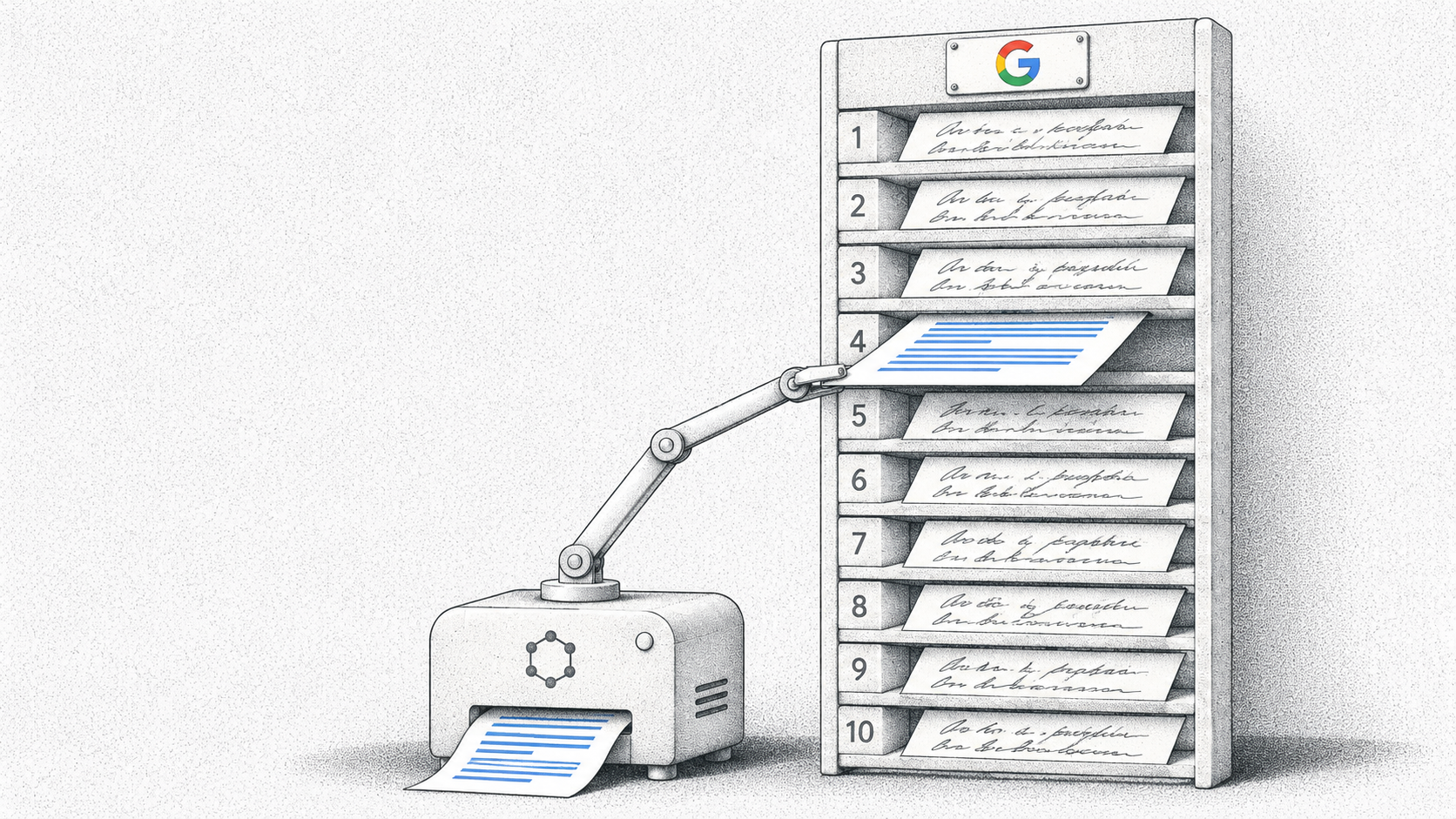
Yes, AI-written content can rank on Google. Google doesn't penalise a page for how it was made, and it hasn't changed that position.
Whether it ranks well is another matter. The latest data shows the top spot still goes mostly to pages a human clearly shaped, and Google has just tightened what it expects from anyone publishing with AI.
What Google actually says about AI content
Google's guidance on generative AI content, updated on 1 October 2026, doesn't ban AI. It calls it "particularly useful when researching a topic, and to add structure to original content". It also says: "It is critical to manually factcheck and review all AI-generated content for accuracy and trustworthiness before publishing."
That review covers your metadata too: page titles, meta descriptions, structured data and image alt text.
The limit is set out in Google's spam policies. "Scaled content abuse" means producing large amounts of unoriginal content "that provides little to no value to users, no matter how it's created". Since May 2026, those policies also apply to AI Overviews and AI Mode, so the same rules decide whether AI answers quote you.
What the ranking data shows
Two large studies this year measured how much AI content actually reaches the top.
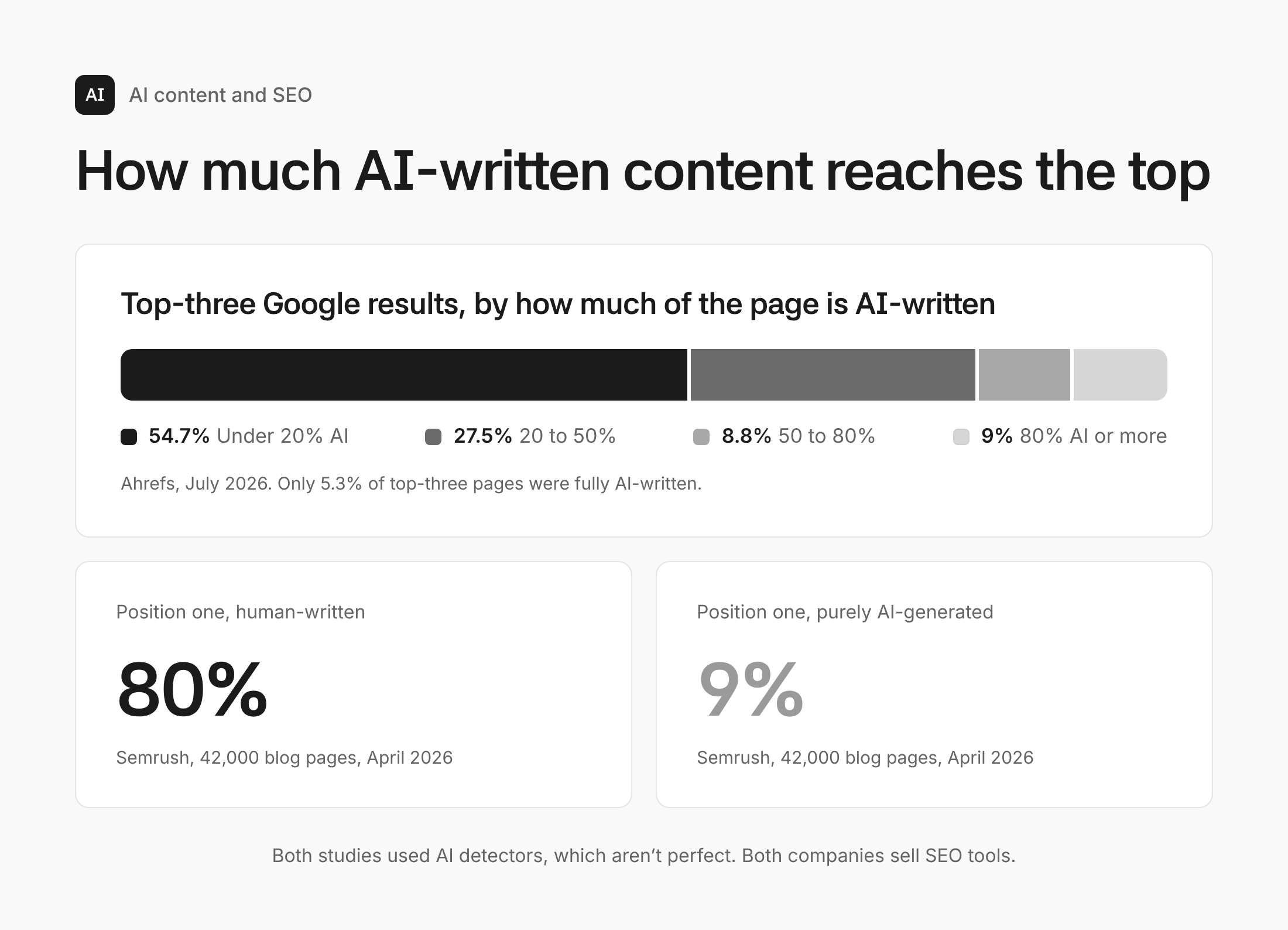
- Ahrefs (July 2026). In its study of top-10 results, only 5.3% of pages in positions one to three were fully AI-written, and pages under 50% AI held 82.2% of top-three spots. Heavily AI pages were also less likely to be indexed: 40.35%, against 49.28% for low-AI pages.
- Semrush (April 2026). Across 42,000 blog pages, content classed as purely AI took the top spot 9% of the time. Human-written content held it 80% of the time.
Both rely on AI detectors, which aren't perfect, and both companies sell SEO tools. Sites that lean on AI may also be newer or weaker, which Ahrefs itself flags. Its conclusion fits the evidence: "Google is not against AI content; it is against bad content".
The data and Google's guidance agree. Pages that anyone could have generated tend to lose out, and unedited AI produces a lot of them.
How to use AI and still rank
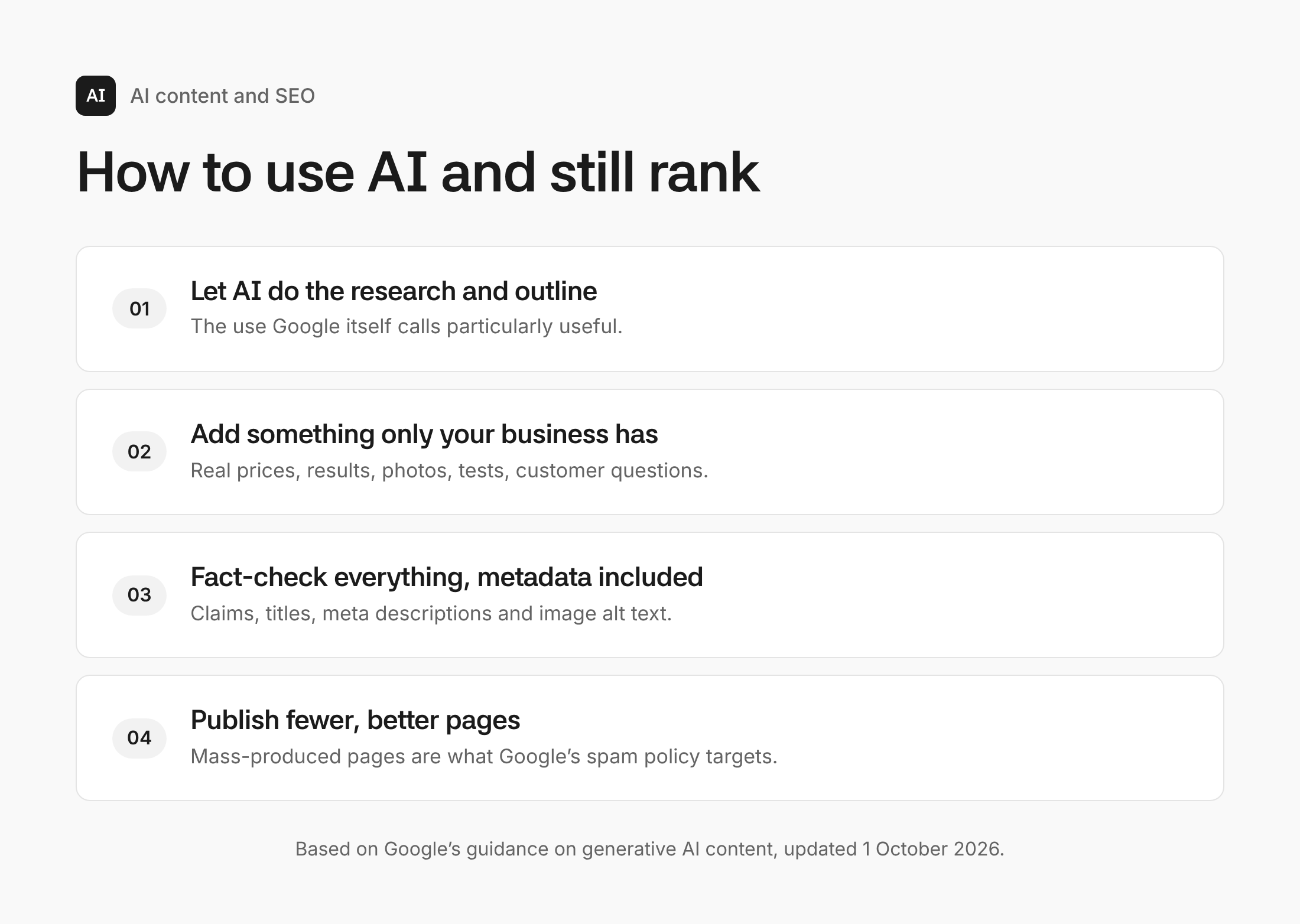
- Let AI do the research and the outline. Google's guidance describes this as a good use of AI.
- Add something only your business has. Real prices, results, photos, a test you ran, the question customers ask every week. It's the same principle behind product descriptions that sell: your details are what the AI can't invent.
- Fact-check every claim. Then check the title, meta description and alt text, which Google now names explicitly. A routine for using AI without it making things up makes this faster.
- Publish fewer, better pages. Ten useful pages beat 100 thin ones, and the 100 are what the spam policy describes.
A prompt that forces the second step before drafting starts:
Before you write anything, ask me five questions about my business, customers and results that would make this article impossible for a competitor to copy. Wait for my answers.
Where AI content goes wrong
- Mass-produced variations. "Best plumber in [city]" pages spun out for 200 towns are textbook scaled content abuse.
- Invented facts. A made-up statistic damages your credibility and now runs directly against Google's own guidance.
- Pages that say what the AI Overview says. If your article could be swapped for Google's own AI summary, nobody has a reason to click, and Google has no reason to send them.
- Unchecked metadata. AI-written titles and alt text are easy to skip reviewing. Google's guidance now names them explicitly.
Get AI advice built around your business
AI Manual is building a service that learns how your business runs and shows you where AI saves time without costing you rankings. It isn't open yet. Contact us and you'll be among the first in.
Put your own business into every page
AI-written content can rank on Google when it's fact-checked and specific to your business. Use AI for research and first drafts, then add the prices, results and customer questions that no competitor's AI can produce.