Do You Have to Tell Customers You Used AI?
Do you have to disclose AI use to customers? Usually not, but chatbots, realistic fakes and reviews have rules. A guide to what the law asks of businesses.
You used AI to draft the newsletter, write the product pages or tidy up a photo. Do your customers need to know?
For most everyday uses, in most places, no law makes you disclose AI use. But there are four specific situations where the answer is yes, and in some of them a fine comes attached. This isn't legal advice, so check anything high-stakes with a lawyer where you trade.
When you don't have to disclose AI use
Writing help you've reviewed and stand behind is generally fine without a label: drafts, emails, product descriptions, blog posts you've edited. Even the strictest rulebook so far, the EU AI Act, exempts AI-generated text that "has undergone a process of human review or editorial control" where someone holds editorial responsibility for it.
The same goes for behind-the-scenes work: brainstorming, summaries, spreadsheets, getting AI to write in your brand's voice. Nobody is misled about anything they rely on.
When you do have to tell customers
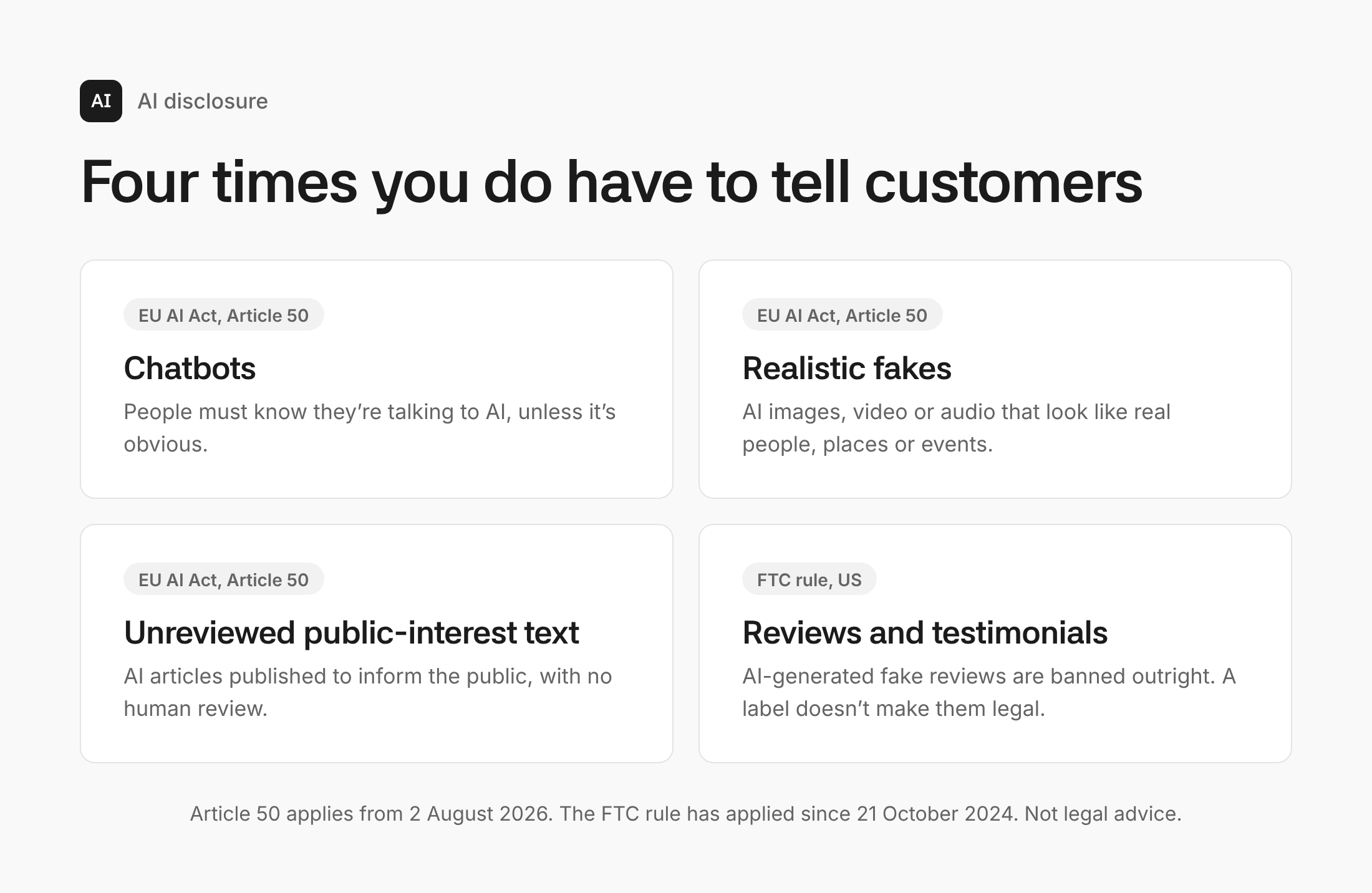
- Chatbots. Under Article 50 of the EU AI Act, which applies from 2 August 2026, people must be told they're dealing with AI unless it's obvious. The design duty sits with whoever builds the chatbot, but if one sits on your site, make sure its first message says it's a bot. A few US states have bot-disclosure laws of their own too.
- Realistic fake images, video or audio. Under the same article, anyone using AI to create or alter content that looks like real people, places or events has to disclose it. Clearly artistic or satirical work gets a lighter touch.
- Auto-published articles on public-interest topics. AI text published to inform the public needs a label if no human reviewed it.
- Reviews and testimonials. In the US, the FTC's rule on fake reviews, in force since 21 October 2024, covers reviews by "someone who does not exist, such as AI-generated fake reviews". They're banned outright, so adding a label doesn't make them legal.
The EU rules reach beyond Europe. They apply to AI output used in the EU, even from a business based elsewhere, according to an analysis by law firm Jones Walker. Fines under Article 99 run up to €15 million or 3% of worldwide turnover, and for small businesses it's whichever of the two is lower. In the US, the FTC could seek up to $51,744 per fake-review violation as of 2024, according to Hogan Lovells, a figure that rises with inflation each year.
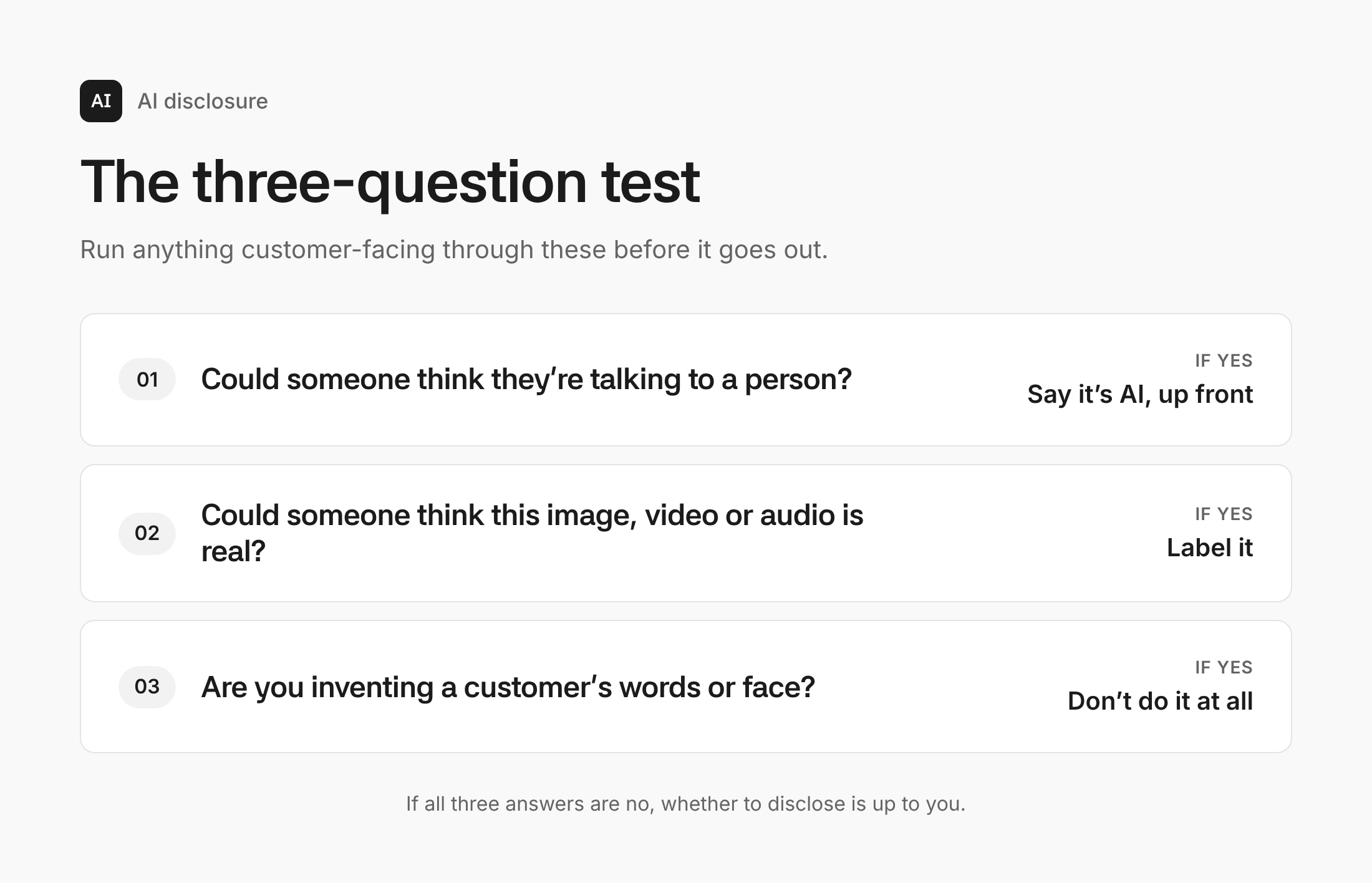
The three-question test
Run anything customer-facing through these:
- Could someone think they're talking to a person? Say it's AI, up front.
- Could someone think this image, video or audio is real? Label it.
- Are you inventing a customer's words or face? Don't do it at all.
If all three are no, whether to disclose is up to you.
When to tell customers anyway
The law only covers part of it. Where customers are paying for your personal craft or judgement, such as illustration, consulting reports or a handwritten-feeling thank-you note, finding out later that AI did the work feels like a bait and switch.
A short line does the job: "Drafted with AI, checked and edited by us." For everything else, from shipping emails to FAQ pages, a label adds nothing.
Where it goes wrong
- The chatbot called "Sarah". A human name and a stock photo on a support bot is exactly what the chatbot rule targets. Call it an assistant.
- AI "customers" in ads. A generated face next to a glowing quote is a fake testimonial, whatever the small print says.
- "Human-made" claims that aren't true. If you sell something as handmade or human-written and it isn't, consumer protection law in most countries can treat that as misleading, regardless of AI rules.
- Assuming no one can tell. Detection tools keep improving and customers are getting better at spotting AI. Read up on how people spot AI-made photos and videos before you bet that yours won't be.
Get AI advice built around your business
AI Manual is building a service that learns how your business runs and shows you where AI fits, including where it needs a label. It isn't open yet. Contact us and you'll be among the first in.
Make sure no customer is misled
Most businesses don't need to label every piece of AI-assisted work. The legal risk sits in a few specific places: a chatbot passing as a person, a realistic fake presented as real, and reviews from customers who don't exist. Keep those out of your marketing and you're within the rules in most countries.