Muse, Duet, Grok Bot and Dots: The Always-On AI Agents Compared
Always-on AI agents compared: Claude Duet, Meta Muse, Grok Bot, OpenAI dots, Gemini Spark, Copilot Cowork and Manus Cue, and which is worth using today.
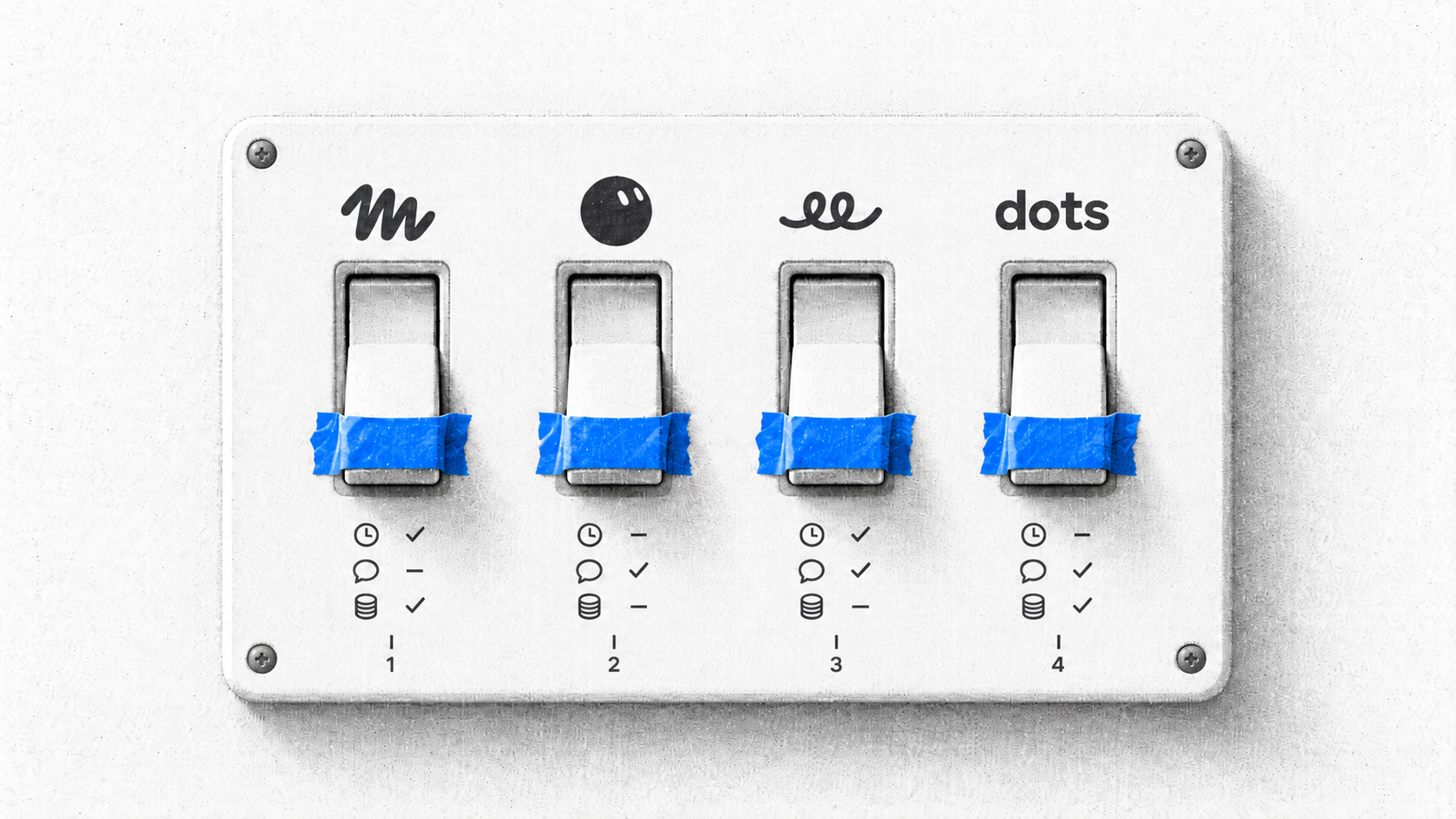
In ten weeks, every big AI company has launched the same new kind of product. xAI released Grok Bot in August. Meta launched Muse in September, OpenAI followed with dots and Manus with Cue a few weeks later, and Anthropic launched Claude Duet this week.
These aren't chatbots. Each one gets its own computer in the cloud, keeps working while yours is switched off, signs into your accounts and messages you when something needs a decision. Several can spend money.
They're also new, uneven and, in several cases, only available in the US. This guide compares the always-on AI agents as of October 2026: what each one does, what it costs, where you can get it, and which is worth a business's time.
What makes these agents different
Earlier AI agents worked while you watched. You gave ChatGPT or Claude a task, it ran in a browser tab, and it stopped when you closed the laptop. If you're new to the idea, AI Manual's guide to what an AI agent is and whether your business needs one covers the basics.
The new products work differently in four ways:
- Their own computer. Each runs on a virtual machine in the cloud, with its own browser.
- Always on. They check your inbox and accounts through the day, and work overnight.
- Proactive. Instead of waiting for instructions, they message you a morning brief and flag what needs attention.
- Able to act. They sign into sites, fill in forms, send messages and, in some cases, pay for things with a virtual card.
The verdict for a business
If you already pay for Claude Pro and you're in the US, Claude Duet is the one to try first: it costs nothing extra and has the strictest guardrails of the group. If your business runs on Microsoft 365, Copilot Cowork is the safest choice, with admin controls and spending caps built in, and it's available worldwide. If you need team-wide controls and can justify $125 a seat, OpenAI's dots has the most detailed rules for what an agent may and may not do. Meta Muse is built for personal errands rather than business, Gemini Spark only works with personal Google accounts, and Grok Bot and Manus Cue are worth watching rather than trusting with business accounts for now.
Claude Duet (Anthropic)
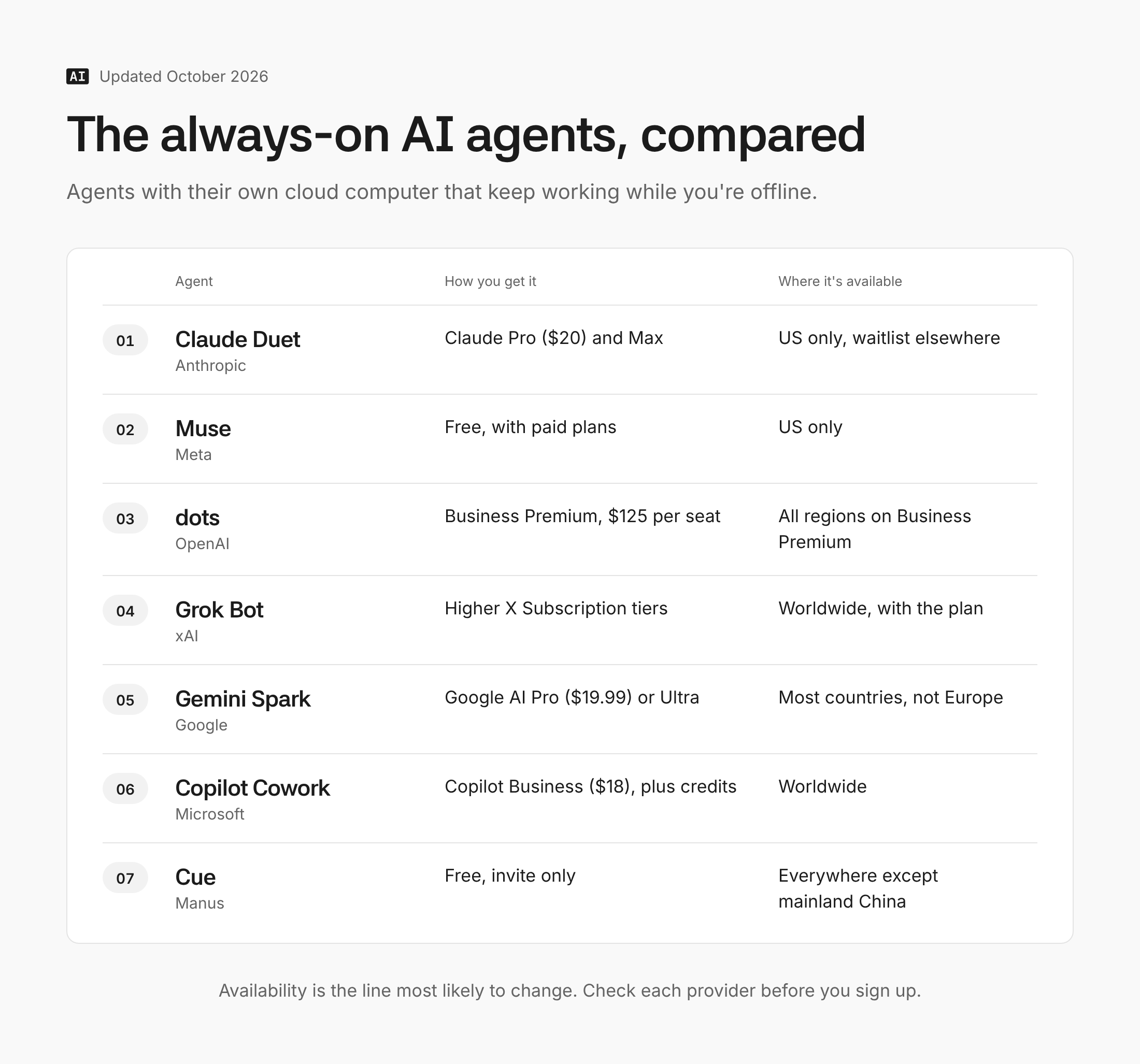
Claude Duet launched on 21 October as a research preview. It runs in its own cloud computer, sends a morning brief, and messages you through the day only when something needs you. It can use thousands of connectors, including Gmail, Slack, QuickBooks, Stripe and Shopify, and can buy things through a virtual card.
- Cost: included in Claude's Pro and Max plans, with no extra fee. Background checks count towards your normal usage limits.
- Where: US only for now. Anthropic says it's "starting today with Pro and Max users in the US", with a waitlist elsewhere.
- Stands out for: the strictest controls of the group. It shows the exact action and waits for approval before it sends, pays, signs or deletes anything, and it refuses to move money between accounts even if you approve.
Meta Muse
Muse launched on 8 September. It runs on its own secure cloud computer, keeps working after you close the app, and can pay using a one-time card. You can give it work through the Muse app or WhatsApp.
- Cost: Meta says it's free "for most of what people need", with paid plans. Axios reports tiers of $20 and $100 a month.
- Where: US only. Meta says Muse "is rolling out in the US".
- Watch out: it's built for personal errands first, with no business tier. Meta's own executives have admitted that people may approve requests without reading them, and some sites, such as restaurant-booking service Resy, have said they'll delete accounts used by automated agents.
OpenAI dots
Dots launched on 29 September. Each dot has its own cloud computer, works on several projects around the clock, connects to thousands of apps and can sign into sites using saved passwords the AI never sees. You can talk to it in ChatGPT, or by voice call.
- Cost: your first dot comes with ChatGPT Pro or a Business Premium seat, which costs $125 per user a month ($100 billed annually).
- Where: Business Premium users get it "across all supported ChatGPT regions". The Pro rollout excludes the European Economic Area, Switzerland and the UK.
- Stands out for: the most detailed controls for a business. You can set rules to allow, block or require approval for specific actions, watch an activity log, and pause a dot at any time.
Grok Bot (xAI)
Grok Bot entered beta on 11 August. Each Bot has its own cloud computer, signs into apps and websites, and learns a routine by watching you do a task once. You can run several at once, including a "chief of staff" Bot that manages the others.
- Cost: included in the higher tiers of the X Subscription bundle launched on 12 October, drawing on a weekly usage allowance shared with Grok and Cursor.
- Where: worldwide. xAI says it opened Grok Bot "to the rest of the world" at launch, and access comes with the plan rather than a country list, so it's available wherever those plans are sold. The Bots' computers run in the US.
- Watch out: Ofcom's investigation into X over Grok-generated sexualised images was still open in October. Ofcom is the UK's online safety regulator, and its investigation is one of several into Grok's content. Giving an agent access to your business accounts means trusting the company behind it, and that's a harder call here than with the others.
Gemini Spark (Google)
Gemini Spark runs background routines across Gmail, Docs, Sheets and Calendar, on a schedule, and can connect to other apps. In October Google moved it behind a "Task" button next to Chat, so you may see it called that.
- Cost: needs Google AI Pro ($19.99 a month in the US) or Ultra.
- Where: Google's release notes say it's available everywhere Gemini is "except in the European Economic Area, Nigeria, Switzerland and the United Kingdom".
- Watch out: it needs a personal Google account, not a Workspace business account, so it can't work inside your company's Google setup yet.
Microsoft Copilot Cowork
Copilot Cowork became generally available in June. You hand it long-running tasks across Microsoft 365, and it works on them in the cloud while your laptop is off, then hands back the finished result. Microsoft announced a more independent version, Copilot Autopilot, in September, but it's still in private preview.
- Cost: needs a Microsoft 365 Copilot Business licence ($18 per user a month on an annual plan), plus metered credits for the work it does.
- Where: worldwide. Microsoft says it's available "to Microsoft 365 Copilot customers worldwide".
- Stands out for: admin controls. It's off by default, and you can set spending caps per person or team.
Manus Cue
Manus, which split from Meta after China blocked the takeover, launched Manus 2.0 and Cue on 28 September. Cue goes furthest of any product here: each agent gets its own email address, phone number, wallet and computer, and can take calls and pay within a budget you set.
- Cost: free in early access, with an invite code.
- Where: everywhere except mainland China. Manus launched 2.0 and Cue for overseas users, with a Chinese version still to come.
- Watch out: in September, security researchers disclosed a flaw that let hidden instructions take over a victim's Manus environment. An agent with its own wallet and phone number needs a strong security record first.
Where it goes wrong
These products are weeks old, and the risks are bigger than with a chatbot because they act while you're not watching.
- Approving on autopilot. Every one of them asks permission before big actions. That only works if you read the request. Meta has admitted people tap "yes" reflexively.
- Hidden instructions. An agent that reads your inbox all day will read emails written to trick it. This is called prompt injection, and the Manus flaw shows it isn't theoretical. Read what you're actually giving AI when you connect your accounts before connecting anything.
- Usage you can't see. Always-on means always using your allowance. Duet's background checks count towards Claude's limits, and Cowork bills in credits. Set caps on day one.
- Sites that ban agents. Some services block or delete accounts that agents use. Check before pointing one at a supplier portal or booking site you depend on.
- Assuming it's available where you are. Most of these launched in the US first, and several exclude Europe. Check the provider's own help page before planning around one.
Find out which agent fits your business
Whether an always-on agent is worth it depends on your tools, your customers and how much a mistake would cost you. AI Manual is building a tool that works that out from a few questions about your business. It isn't open yet. Contact us and you'll be among the first in.
FAQ
What is an always-on AI agent?
It's an AI agent with its own computer in the cloud that keeps working when you're offline. It checks your accounts through the day, handles routine jobs and messages you when something needs a decision, rather than waiting for you to ask.
Which always-on agents are available outside the US?
As of October 2026: Microsoft Copilot Cowork and Grok Bot worldwide, OpenAI dots on ChatGPT Business Premium in all supported regions, Gemini Spark in most countries outside Europe, and Manus Cue everywhere except mainland China, by invitation. Claude Duet and Meta Muse are US-only for now.
Is Claude Duet better than Meta Muse?
For a business, Duet looks the more cautious of the two: it connects to business tools like QuickBooks and Shopify, and it refuses some money moves even with approval. Both are US-only and weeks old, and neither has been tested independently, so treat any comparison as provisional.
Can these agents spend my money?
Several can. Duet, Muse and Cue can pay using virtual cards or a budget you set, and all ask for approval first. Start with spending switched off and add it only once you trust what the agent is doing.
The takeaway
The always-on agent is the biggest change in AI products this year, but it's still early. Pick the one that fits the tools you already use, give it one low-risk weekly job, such as a morning summary of your inbox, and keep spending switched off until you've watched it work for a few weeks. This market is moving monthly, and AI Manual will keep this comparison updated.